
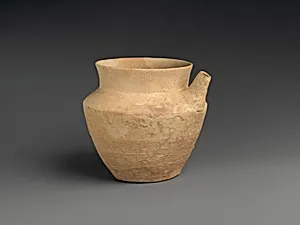
Spouted jar
Unknown Artist
ca. 2900–2700 BCE
Medium
Ceramic
Dimensions
5 1/2 × 6 5/16 × 6 5/16 in. (14 × 16 × 16 cm)
Classification
Ceramics-Vessels
Culture & Period
Sumerian · Early Dynastic I
Department
Ancient Near Eastern Art
Museum
Metropolitan Museum of Art, New York, NY
Credit
Rogers Fund, 1962
Accession Number
62.70.22
Rights
Public Domain
Art Historical Context
This elegant spouted jar, crafted 2900–2700 BCE during Sumeria's Early Dynastic I period exemplifies the ingenuity of one of the world's earliest urban civilizations in ancient Mesopotamia. Hailing from the cradle of city-states like Uruk and Ur, this ceramic vessel measures a compact 5½ × 6⅜ × 6⅜ inches, making it ideal for household or ritual use. Sumerians, pioneers in writing, agriculture, and monumental architecture, relied on such pottery for storing and pouring liquids like water, oils, or grainThe jar's distinctive spout—a practical innovation—facilitated controlled pouring, highlighting the functional artistry of Sumerian potters. Made from fired clay, likely wheel-thrown or hand-built and then burnished for a smooth finish, it reflects early mastery of ceramic techniques that supported daily life and temple offerings. These vessels were essential in a society where rivers like the Tigris and Euphrates shaped economy and ritual. Today, at the Metropolitan Museum of Art (Rogers Fund, 1962), this unadorned yet graceful piece invites us to ponder the anonymous artisan's skill, bridging us to Sumer's foundational legacy in human innovation.