
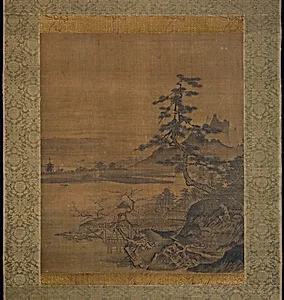
Spring View from a Thatched Pavilion on the Lakeshore
late 15th century
Medium
Album leaf mounted as a hanging scroll; ink and light colors on silk
Dimensions
Painting: 42 × 35.3 cm (16 9/16 × 13 15/16 in.); Overall: 128 × 53.3 cm (50 7/16 × 21 in.)
Classification
hanging scroll
Department
Arts of Asia
Museum
Art Institute of Chicago
Accession Number
16682
Rights
Public Domain
Art Historical Context
This delicate hanging scroll, created in the late 15th century by an artist from the School of Sesshu, captures a tranquil spring landscape viewed from a thatched pavilion a lake. The work exemplifies the refined ink-and-light-color technique on silk that defined Japanese landscape painting during the Muromachi period. Originally an album leaf, it was later mounted as a scroll, allowing it to be appreciated in the intimate, contemplative settings of temples or scholarly retreats. Sesshu (1420–1506), a Zen Buddhist monk and one of Japan’s most celebrated painters, drew inspiration from Chinese Song and Yuan dynasty landscapes while developing a distinctly Japanese aesthetic of simplicity and spiritual depth. His followers continued this tradition, using subtle washes of ink and faint color to evoke seasonal atmosphere rather than precise detail. The modest scale of the painting—roughly 16 by 14 inches—invites close viewing, encouraging the viewer to imagine the gentle breeze and blooming scenery outside the pavilion. As part of the Art Institute of Chicago’s Arts of Asia collection, the scroll reflects the deep cultural exchange between Japan and continental Asia while highlighting Zen ideals of harmony with nature. Its restrained palette and balanced composition continue to offer modern audiences a quiet moment of reflection on the passing seasons.