
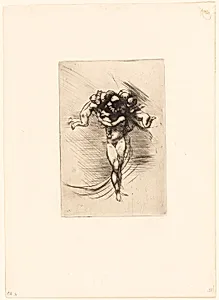
Springtime
c. 1878
Medium
Drypoint on ivory laid paper
Dimensions
Image: 14.8 × 10.1 cm (5 7/8 × 4 in.); Plate: 14.8 × 10.1 cm (5 7/8 × 4 in.); Sheet: 27.8 × 20.1 cm (11 × 7 15/16 in.)
Classification
drypoint
Department
Prints and Drawings
Museum
Art Institute of Chicago
Accession Number
111368
Rights
Public Domain
Art Historical Context
Auguste Rodin’s *Springtime* (c. 1878) offers a rare glimpse into the celebrated sculptor’s work on paper. Best known for monumental bronzes that revolutionized modern sculpture, Rodin here explores the intimate medium of drypoint, scratching directly into a copper plate to produce soft, velvety lines characteristic of the technique. Printed on delicate ivory laid paper, the small-scale image captures the freshness and vitality suggested by its title, reflecting the artist’s lifelong fascination with the human form and natural cycles of renewal. Created during Rodin’s formative years in Paris, this print coincides with a period when he was transitioning from decorative work to independent sculpture. Drypoint’s direct, almost sculptural approach—where the raised burr of metal holds ink to create rich, tactile textures—allowed him to experiment with light, shadow, and spontaneity in a manner akin to his modeling of clay. Though modest in size, the work demonstrates Rodin’s versatility across media and his interest in conveying movement and emotion through line. Today housed in the Art Institute of Chicago’s Prints and Drawings collection, *Springtime* reminds visitors that even a master of three dimensions found expressive power in two. The print’s quiet lyricism invites close looking, revealing how Rodin’s innovative spirit extended from monumental marble and bronze into the subtle world of graphic art.
About the Artist
Auguste Rodin · 1840–1917
François Auguste René Rodin (1840-1917) stands as the founder of modern sculpture, transforming the art form from academic tradition into expressive modernism. Born into a working-class Parisian family, Rodin faced early rejection, failing three times to gain admission to the prestigious École des Beaux-Arts. This setback forced him to work as a craftsman for nearly two decades, though his 1875 tr...