
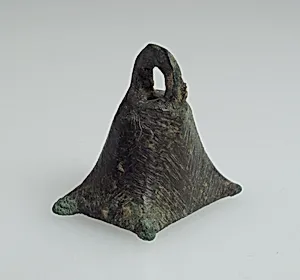
Square Pyramidal Bell
Unknown Artist
6th–7th century (?)
Medium
Copper alloy
Dimensions
Overall: 1 1/2 x 1 1/2 x 1 1/8 in. (3.8 x 3.8 x 2.8 cm)
Classification
Metalwork-Copper alloy
Culture
Frankish (?)
Department
Medieval Art
Museum
Metropolitan Museum of Art, New York, NY
Credit
Gift of J. Pierpont Morgan, 1917
Accession Number
17.193.278
Rights
Public Domain
Art Historical Context
This delicate **Square Pyramidal Bell**, crafted from copper alloy around the 6th–7th century exemplifies the refined metalworking skills of early medieval Europe. just 1 1/2 x 1 1/2 x 1 1/8 inches its compact pyramidal form—square base tapering to a pointed apex—suggests it was portable object, perhaps a handbell or signaling device. The use of copper alloy, a and malleable material, allowed artisans to cast intricate shapes through techniques like lost-wax casting, highlighting the technical prowess of the era's workshops. Likely of Frankish origin, this bell emerges from the Merovingian period, when the Franks dominated much of Western Europe, blending Germanic traditions with emerging Christian influences. Small bells like this held practical and symbolic roles: summoning clergy, marking rituals, or serving pilgrims on the road. Its presence in the Metropolitan Museum of Art's Medieval Art collection, gifted by J. Pierpont Morgan in 1917, underscores its rarity as a window into everyday life and devotion in a transformative age. Though the artist remains unknown, the bell's survival speaks to the enduring craftsmanship of Frankish metalworkers, inviting us to ponder the sounds that once echoed through early medieval halls.