
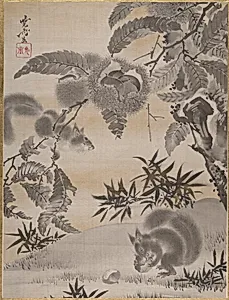
Squirrels Gathering Chestnuts
ca. 1887
Medium
Album leaf; ink and gold on silk
Dimensions
14 1/4 x 10 3/4 in. (36.2 x 27.3 cm)
Classification
Paintings
Culture & Period
Japan · Meiji period (1868–1912)
Department
Asian Art
Museum
Metropolitan Museum of Art, New York, NY
Credit
Charles Stewart Smith Collection, Gift of Mrs. Charles Stewart Smith, Charles Stewart Smith Jr., and Howard Caswell Smith, in memory of Charles Stewart Smith, 1914
Accession Number
14.76.61.27
Rights
Public Domain
Tags
Art Historical Context
In the whimsical *Squirrels Gathering Chestnuts*, created around 1887 by the eccentric Japanese artist Kawanabeōsai, a lively scene unfolds on a delicate album leaf of ink and gold on silk Measuring just 14¼ x 10¾ inches, this intimate format was prized in Japan for personal albums, allowing collectors to savor small-scale masterpieces. Kyōsai, a master of the late Edo and early Meiji periods, infuses the composition with his signature humor and dynamic brushwork, depicting squirrels in anthropomorphic antics—busily foraging amid autumnal abundance. During Japan's Meiji era (1868–1912), a time of rapid modernization and Western influence, Kyōsai clung to traditional ink painting while injecting satirical flair, often drawing animals as lively characters to poke fun at human follies. The use of gold flecks on silk evokes the opulence of classical Japanese screens and scrolls, catching light to mimic shimmering foliage or fur, a technique rooted in centuries-old yamato-e styles. This charming work, now in the Metropolitan Museum of Art's Asian Art collection (gift of the Charles Stewart Smith family, 1914), highlights Kyōsai's enduring legacy as one of Japan's last great ukiyo-e innovators—bridging whimsy with profound artistic tradition. Visitors can't help but smile at these furry protagonists, a delightful window into Meiji Japan's playful spirit.
About the Artist
Kawanabe Kyōsai 河鍋暁斎 (Japanese) · 1831 –1889
Japanese, 1831–1889