
St. Andrews
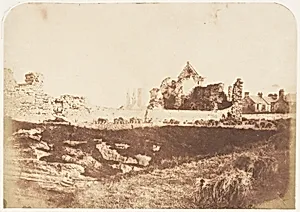
Medium
Salted paper print from paper negative
Classification
Photographs
Department
Photographs
Museum
Metropolitan Museum of Art, New York, NY
Credit
Harris Brisbane Dick Fund, 1937
Accession Number
37.98.1.7
Rights
Public Domain
Tags
Art Historical Context
Welcome to the Metropolitan Museum of Art's photography collection, where *St. Andrews* (1843–47) by David Octavius Hill and Robert Adamson transports us to the dawn of photography. This salted paper print from a paper negative captures the evocative ruins of St. Andrews in Scotland—a once-grand medieval structure reduced to haunting remnants by the Reformation. The partners, often credited together as Hill and Adamson, pioneered the calotype process in the 1840s, blending Hill's artistic eye as a painter with Adamson's technical mastery in chemistry. The calotype's paper negative produced soft, painterly images with subtle tones and textures, distinguishing it from sharper daguerreotypes. This medium lent a romantic, atmospheric quality to architectural subjects like these ruins, evoking Scotland's layered history of faith and decay. Produced amid their landmark collaboration to document the Free Church of Scotland's founding, the print exemplifies early photography's role in preserving vanishing heritage. A gem from the Harris Brisbane Dick Fund, *St. Andrews* highlights how 19th-century innovators like Hill and Adamson elevated photography to fine art, inviting us to ponder time's gentle erosion on stone and memory alike.
About the Artist
David Octavius Hill|Robert Adamson|Hill and Adamson · 1802–1870
David Octavius Hill (1802–1870) was a Scottish painter, photographer, and arts administrator whose pioneering photography partnership with Robert Adamson from 1843 to 1847 transformed the medium into an art form. Born in Perth and trained in Edinburgh, Hill established himself as a landscape painter and became secretary of the Royal Scottish Academy, a position he held for nearly forty years. His ...