
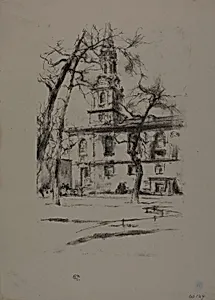
St. Giles-in-the-Fields
Medium
Transfer lithograph in black with stumping, on cream laid paper
Dimensions
Image: 21.7 × 14.2 cm (8 9/16 × 5 5/8 in.); Sheet: 28.6 × 21 cm (11 5/16 × 8 5/16 in.)
Classification
transfer lithograph
Department
Prints and Drawings
Museum
Art Institute of Chicago
Accession Number
139508
Rights
Public Domain
Art Historical Context
James McNeill Whistler, the renowned American-born artist celebrated for his Aesthetic movement ideals and subtle tonal harmonies, captured the evocative London scene of *St. Giles-in-the-Fields* in 1896. This transfer lithograph depicts the historic church in the Soho district, a poignant slice of urban life amid Whistler's late-career fascination with everyday cityscapes. Created during a period when Whistler experimented with printmaking to evoke the misty atmospheres of his famous Nocturnes, the work reflects his philosophy of "art for art's sake," prioritizing mood over narrative detail. Printed in black ink with stumping—a technique using a soft tool to blend and soften tones on cream laid paper—the medium allowed Whistler to achieve painterly effects akin to his oil paintings. Transfer lithography, where the artist draws on paper that is then chemically transferred to a lithographic stone, enabled fluid, spontaneous lines and rich gradations (image: 21.7 × 14.2 cm). Housed in the Art Institute of Chicago's Prints and Drawings department, it exemplifies Whistler's mastery in translating subtle light and shadow into intimate prints. This modest yet masterful piece highlights Whistler's influence on modern printmaking, bridging 19th-century realism with impressionistic subtlety, inviting viewers to linger on the quiet poetry of London's streets.
About the Artist
James McNeill Whistler · 1834–1903
James Abbott McNeill Whistler (1834-1903) was an American-born painter and printmaker who became a leading figure in the Aesthetic Movement and pioneer of Tonalism and Japonisme. He revolutionized art by championing "art for art's sake" and treating paintings as visual equivalents of musical compositions, titling works as "arrangements," "harmonies," and "nocturnes" to emphasize formal qualities o...