
St. Jerome
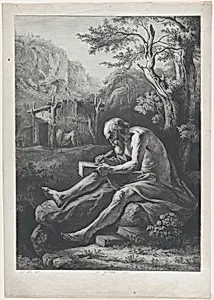
Medium
Etching with drypoint, burin and roulette; fifth state of six
Dimensions
Sheet: 19 3/8 × 13 7/16 in. (49.2 × 34.2 cm)
Classification
Prints
Department
Drawings and Prints
Museum
Metropolitan Museum of Art, New York, NY
Credit
Purchase, The Elisha Whittelsey Collection, The Elisha Whittelsey Fund, 1967
Accession Number
67.798.2
Rights
Public Domain
Tags
Art Historical Context
In the tranquil etching *St. Jerome* (1797), French printmaker Jean-Jacques de Boissieu captures the iconic Church Father in a moment of deep contemplation. Seated amid scholarly pursuits—likely penning his Vulgate translation of the Bible—St. Jerome is accompanied by symbolic lion, evoking the legend of the saint removing a thorn from the beast's paw. Created during the turbulent post-Revolutionary era in France, this work reflects a enduring fascination with religious iconography, blending spiritual devotion with artistic virtuosity. Boissieu's mastery shines in this fifth state of six, a progressive proof showcasing etching for fluid lines, drypoint for velvety burr, burin for crisp engraving, and roulette for textured shading. Measuring 19 3/8 × 13 7/16 inches, the large sheet allows intricate details to emerge, from the saint's furrowed brow to the lion's watchful gaze. As a rare multi-technique intaglio print, it exemplifies late 18th-century experimentation in printmaking, bridging Rococo elegance with emerging Romantic depth. Housed in The Metropolitan Museum of Art's Drawings and Prints department, this piece invites visitors to ponder St. Jerome's role as patron of scholars and translators—a timeless emblem of intellect amid wilderness solitude.
About the Artist
Jean Jacques de Boissieu · 1736–1810
French, Lyons 1736–1810 Lyons