
St Jerome in the Desert
Medium
Engraving
Dimensions
Sheet: 12 5/8 × 10 9/16 in. (32.1 × 26.9 cm)
Classification
Prints
Department
Drawings and Prints
Museum
Metropolitan Museum of Art, New York, NY
Credit
The Elisha Whittelsey Collection, The Elisha Whittelsey Fund, 1959
Accession Number
59.570.158
Rights
Public Domain
Tags
Art Historical Context
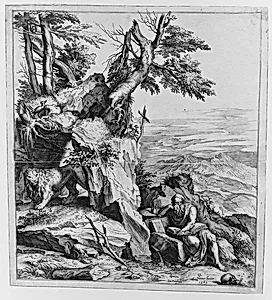
In the hushed solitude of the desert, *St. Jerome in the Desert* captures the early Christian saint in a moment of profound contemplation and penance. Created in 1565 as an by Dutch master printmaker Cornelis Cort after composition by the Venetian Renaissance giant Titian (Tiziano Vecellio), this draws from Titian's vibrant late style, known for its dramatic lighting and emotional depth. Saint Jerome, often shown as a scholarly hermit with his loyal lion, skull, and crucifix amid sparse trees and arid landscapes, symbolizes spiritual withdrawal and redemption—a popular theme in Counter-Reformation art. Engraving, Cort's specialty, allowed Titian's oil paintings to reach a wider audience through precise, intricate lines etched into copper plates, producing rich tonal contrasts and textures on paper. Measuring 12 5/8 × 10 9/16 inches, this print exemplifies the reproductive print's role in 16th-century Europe, disseminating Italian High Renaissance ideals northward. Housed in the Metropolitan Museum of Art's Drawings and Prints department, it highlights how prints bridged artistic traditions, making Titian's genius accessible beyond elite patrons. Visitors will appreciate the meticulous detail—the weathered cross, desert flora, and Jerome's introspective pose—evoking timeless themes of faith amid isolation. A testament to collaborative genius, it invites reflection on art's power to transcend medium and era.
About the Artist
Cornelis Cort|Titian (Tiziano Vecellio) · 1533–1578
Comment on works: copper engraver; engraver; etcher