
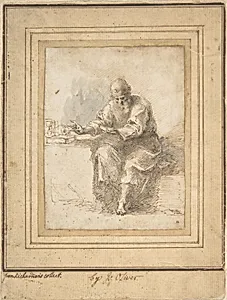
St. Jerome Reading
16th–17th century
Medium
Pen and brown ink, brush and brown and gray wash
Dimensions
sheet: 4 5/8 x 3 9/16 in. (11.7 x 9 cm) mount: 7 3/8 x 5 11/16 in. (18.8 x 14.4 cm)
Classification
Drawings
Department
Drawings and Prints
Museum
Metropolitan Museum of Art, New York, NY
Credit
Purchase, 2004
Accession Number
2004.263
Rights
Public Domain
Tags
Art Historical Context
Isaac Oliver's *St. Jerome Reading*, delicate drawing from the late16th to early 17th century, captures the revered saint in a moment of quiet contemplation. Rendered in pen and brown ink with brush brown and gray wash on modest sheet measuring just 4 5/8 x 3 9/16 inches, this intimate work exemplifies the precision of English Renaissance draftsmanship. Oliver, a master miniaturist known for his luminous portrait enamels and limnings at the courts of Elizabeth I and James I, here turns his skilled hand to religious iconography, portraying St. Jerome—the scholar-saint famed for translating the Bible into Latin—as immersed in study. The artwork's small scale and monochromatic palette invite close viewing, much like peering into a scholar's private world. The brown ink lines define Jerome's contemplative pose and flowing robes with fine hatching, while subtle gray washes model form and shadow, creating depth on the tiny surface. This technique, common in preparatory studies for paintings or miniatures, highlights Oliver's versatility beyond portraiture, blending Flemish influences with English subtlety during a time when religious imagery persisted amid Reformation tensions. Acquired by The Metropolitan Museum of Art in 2004, this drawing from the Drawings and Prints department offers a window into the era's devotional art. Its tags—evoking saints and the act of reading—remind us of Jerome's enduring symbol of intellectual piety, making it a gem for visitors drawn to the hushed drama of scholarly saints.