
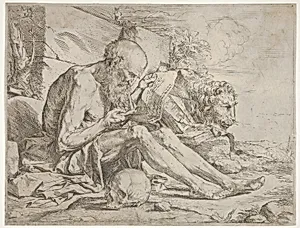
St. Jerome seated on the ground and reading an inscribed scroll, a skull next to his right leg and a lion beyond
Medium
Etching and engraving
Dimensions
plate: 7 1/2 x 9 13/16 in. (19 x 24.9 cm) sheet: 7 11/16 x 10 in. (19.5 x 25.4 cm)
Classification
Prints
Department
Drawings and Prints
Museum
Metropolitan Museum of Art, New York, NY
Credit
Bequest of Phyllis Massar, 2011
Accession Number
2012.136.298
Rights
Public Domain
Tags
Art Historical Context
In this striking etching and engraving from around 1624, Jusepe de Ribera—known as "Lo Spagnoletto" (the Little Spaniard)—captures the ascetic life of St. Jerome, the 4th-century scholar and Doctor of the Church. A leading figure in the Spanish Baroque Ribera worked primarily in Naples, drawing on Caravaggesque tenebrism to infuse his works with dramatic light and shadow, heightening emotional and spiritual intensity. This print, measuring about 7½ by 9⅞ inches, exemplifies his mastery of printmaking, a medium that allowed broader dissemination of religious imagery during the Counter-Reformation era. Seated humbly on the ground, St. Jerome pores over an inscribed scroll, symbolizing his translation of the Bible into Latin (the Vulgate). A skull rests by his right leg as a memento mori, reminding viewers of mortality and penance, while a lion lurks beyond—recalling the legend where Jerome removed a thorn from the beast's paw, taming it as a faithful companion in the desert. These motifs underscore themes of contemplation, humility, and divine study, resonating with 17th-century audiences seeking spiritual solace. Ribera's meticulous etching and engraving techniques yield rich textures and subtle gradations, making this intimate work a gem of Baroque print art. Now in the Metropolitan Museum of Art's Drawings and Prints department, thanks to the 2011 bequest of Phyllis Massar, it invites us to reflect on enduring symbols of faith and human frailty.