
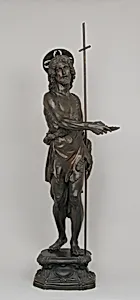
St. John the Baptist
19th century, after 16th century original
Medium
Bronze
Dimensions
Height: 41 in. (104.1 cm)
Classification
Metalwork-Electrotype
Culture
British, after Italian original
Department
European Sculpture and Decorative Arts
Museum
Metropolitan Museum of Art, New York, NY
Credit
Purchase, 1873
Accession Number
73.8.60
Rights
Public Domain
Tags
Art Historical Context
Behold the striking *St. John the Baptist*, a 19th-century bronze electrotype reproduction of a masterful 16th-century original Giambologna (Jean de Boulogne the eminent Flemish-Italian Mannerist sculptor. Standing at an impressive 41 inches tall this sculpture captures the saint in a dynamic, twisting pose characteristic of Mannerism—a style that emphasized elegance, complexity, and anatomical virtuosity over Renaissance harmony. Giambologna, active in Florence under the Medici patronage, was renowned for his fluid bronze figures that seem to defy gravity, influencing generations of sculptors across Europe. Crafted using the innovative electrotype process—a 19th-century British technique that electrochemically replicates metal originals with remarkable fidelity—this piece reflects the Victorian era's passion for classical revival and museum collecting. Acquired by the Metropolitan Museum of Art in 1873, it resides in the European Sculpture and Decorative Arts department, offering visitors a tangible link to Renaissance Italy. Saint John the Baptist, the prophet who heralded Christ, holds profound cultural resonance in Christian art, symbolizing penance and divine prophecy. This accessible electrotype democratized access to Giambologna's genius, blending artistry with technological ingenuity for enduring admiration.
About the Artist
Giambologna · 1529–1608
Born and trained in Flanders (Douai, his birthplace, is now in France but was once in Flanders), Giambologna traveled to Italy in 1550 to study Classical and Renaissance sculpture. There, he became court sculptor of the Medici Dukes. He was famed for compositional sophistication, sensuous, tactile treatment of human body, and sheer technical virtuosity. He was extremely influential because the Med...