
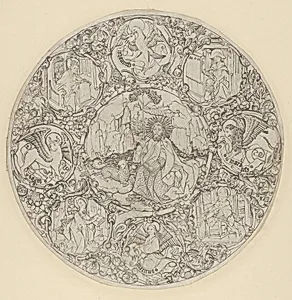
St. John the Baptist in the Desert
15th century
Medium
Engraving; second state
Dimensions
Sheet: 7 1/4 × 7 7/16 in. (18.3 × 18.9 cm)
Classification
Prints
Department
Drawings and Prints
Museum
Metropolitan Museum of Art, New York, NY
Credit
Harris Brisbane Dick Fund, 1922
Accession Number
22.83.10
Rights
Public Domain
Tags
About this artwork
St. John the Baptist in the Desert is an engraving by Master ES, created in the 15th century between 1445 and 1467. The work exemplifies the early development of printmaking in Germany and represents one of the earliest examples of fine art engraving in Europe. The print depicts St. John the Baptist in a wilderness setting, identifiable by his traditional attributes including animal skin garment and staff. The composition demonstrates Master ES's sophisticated use of line work to create modelin...
Art Historical Context
Step into the wild, contemplative world of *St. John the Baptist the Desert*, a masterful 15th-century engraving by the enigmatic Master ES (active ca. 1450–67). Created between 1445 and 1467, this second-state print captures the saint in his rugged wilderness retreat, clad in his traditional animal-skin garment and leaning on a staff. Subtle details like birds, animals, and flowers evoke a of divine harmony amid nature, drawing viewers into a moment of spiritual solitude during the late Gothic era. Master ES, one of Germany's pioneering printmakers, revolutionized the medium with his sophisticated burin work—incising fine lines into a copper plate for inking and pressing onto paper. This intaglio technique allowed multiple high-quality impressions, making sacred art accessible beyond elite manuscripts and paintings. His precise line work builds remarkable modeling, texture, and atmospheric depth, as refined in this second state, showcasing his iterative artistry across some 320 known engravings, 18 monogrammed with his "ES" mark. As an early pinnacle of European fine art engraving, the work (7¼ × 7⅜ in.) set standards that inspired giants like Martin Schongauer and Albrecht Dürer. Acquired via the Harris Brisbane Dick Fund in 1922, it highlights printmaking's rise in Northern Europe, blending religious devotion with decorative elegance for devout audiences of the time.
About the Artist
Master ES (German) · 1445 –1467
German, active ca. 1450–67