
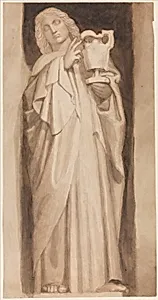
St. John the Evangelist
ca. 1811
Medium
Brush and brown wash over graphite
Dimensions
Sheet: 28 15/16 × 15 1/16 in. (73.5 × 38.3 cm)
Classification
Drawings
Department
Drawings and Prints
Museum
Metropolitan Museum of Art, New York, NY
Credit
The Elisha Whittelsey Collection, The Elisha Whittelsey Fund, 2013
Accession Number
2013.614
Rights
Public Domain
Tags
About this artwork
This monumental drawing depicts St. John the Evangelist as one of a series of statues that adorn the Lady Chapel of Westminster Abbey around the tomb of Henry VII. British neoclassical sculptor John Flaxman created this work around 1811 as a visual aid for his inaugural lecture as Professor of Sculpture at the Royal Academy of Arts. Executed in brush and brown wash over graphite, the large-scale sheet presents the saint in classical drapery with bold, deliberately broad handling designed to be v...
Art Historical Context
John Flaxman’s *St. John the Evangel* (ca. 1811) is a striking neoclassical drawing that captures the figure of the saint from one of the medieval statues gracing the niches of Westminster Abbey’s Lady Chapel. This chapel, encircling the tomb of VII, represents the pinnacle of English Gothic architecture—hailed by 16th-century antiquarian Leland as “the wonder of the entire.” Flaxman, a leading British sculptor (1755–1826) renowned for his reliefs, funerary monuments, and illustrations of classical texts, created this work as a visual aid for his inaugural lecture as the Royal Academy’s first Professor of Sculpture in 1810. Executed in brush and brown wash over graphite on a grand scale—nearly 29 by 15 inches—the drawing translates the three-dimensional medieval sculpture into a bold, two-dimensional form. Flaxman’s deliberate broad strokes and classical drapery emphasize sculptural principles, designed for clear visibility from afar in the lecture hall. This pedagogical masterpiece reveals his analytical eye and deep respect for Gothic craftsmanship, bridging medieval heritage with neoclassical ideals. Housed in the Metropolitan Museum of Art’s Drawings and Prints department, this sheet not only showcases Flaxman’s technical prowess but also underscores the enduring cultural reverence for Westminster Abbey’s sculptures, inviting us to appreciate the dialogue between eras in art history.
About the Artist
John Flaxman · 1755–1826
John Flaxman (1755–1826) was born in York, England, the son of John Flaxman Sr., a moulder and seller of plaster casts who ran a studio in London's Covent Garden. Largely self-taught amid his father's stock of classical casts, with minimal formal schooling due to childhood illness, Flaxman displayed prodigious talent early on. At age 12, he won a Society of Arts prize for a medallion; by 15, anoth...