
St. Mederic, Abbot; Beheading of John the Baptist; St. Fiacre; Festival of the Belt of the Virgin
c. 1632/1635
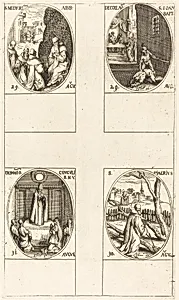
Medium
etching on laid paper
Dimensions
plate: 21 × 12.3 cm (8 1/4 × 4 13/16 in.) sheet: 24.7 × 14.2 cm (9 3/4 × 5 9/16 in.)
Classification
Department
CG-E
Museum
National Gallery of Art, Washington, D.C.
Credit
R.L. Baumfeld Collection
Accession Number
1969.15.717
Rights
Public Domain
Art Historical Context
Jacques Callot's *St. Mederic, Abbot Beheading of John the; St. Fiacre; Festival of the Belt of the Virgin* (c. 1632/1635) is a etching that captures multiple religious vignettes in a compact 21 × 12.3 cm plate. The renowned French Baroque printmaker, active across Europe, deftly combines scenes of saintly devotion—honoring St. Mederic, theheading of John the Baptist healer St. Fiacre a miraculous festival tied to the Virgin Mary's belt relic in Prato, Italy. This work reflects the Counter-Reformation's fervor, blending hagiography with dramatic biblical narrative to inspire faith among 17th-century viewers. Callot's etching technique shines here, employing his innovative use of multiple biting and fine lines on laid paper to achieve extraordinary detail and tonal depth in such a diminutive format. A pioneer in reproductive printmaking, he produced vast series like the *Petite Misères de la Guerre*, but religious prints like this one highlight his skill in popular piety, making sacred stories accessible for homes and pilgrims. Housed in the National Gallery of Art's R.L. Baumfeld Collection, it exemplifies how prints democratized art during the Baroque era, bridging elite patronage and everyday devotion.
About the Artist
Jacques Callot · 1592–1635
Jacques Callot (1592–1635) was a French printmaker and draftsman from the Duchy of Lorraine, widely regarded as one of the first great artists to practice the graphic arts exclusively. His more than 1,400 etchings chronicled the breadth of 17th-century life, from Medici court festivities to the brutal realities of warfare. Callot revolutionized etching through technical innovations including the é...