
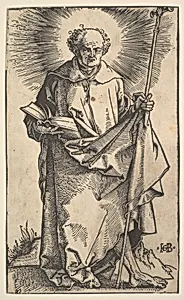
St. Philip from Christ and the Apostles
Medium
Woodcut
Dimensions
Sheet: 8 1/8 × 4 15/16 in. (20.7 × 12.5 cm)
Classification
Prints
Department
Drawings and Prints
Museum
Metropolitan Museum of Art, New York, NY
Credit
Harris Brisbane Dick Fund, 1924
Accession Number
24.28.14
Rights
Public Domain
Tags
Art Historical Context
Hans Baldung Grien’s woodcut *St. Philip from Christ and the Apostles* (1519) presents the apostle in a dignified, introspective pose typical of early sixteenth-century devotional imagery. A leading German artist of the Northern Renaissance and a close associate of Albrecht Dürer, Baldung was celebrated for his expressive woodcuts that combined bold linear patterns with a vivid sense of human presence. This small sheet, measuring roughly 8 by 5 inches, once formed part of a series portraying Christ and the twelve apostles, images designed to be affordable and widely circulated. Woodcut printing was especially significant at this moment, as the technique allowed artists to reproduce detailed religious subjects on paper for broad distribution across Europe. Baldung’s crisp lines and careful attention to drapery folds give St. Philip a monumental quality despite the print’s modest scale, reflecting the era’s renewed interest in individual character within sacred narratives. Such works helped shape how ordinary viewers encountered the apostles, blending artistic innovation with spiritual instruction. Acquired by the Metropolitan Museum of Art in 1924 through the Harris Brisbane Dick Fund, the print remains a fine example of Renaissance graphic art that continues to invite quiet reflection on faith and craftsmanship.
About the Artist
Hans Baldung (called Hans Baldung Grien) · 1484–1545
Hans Baldung Grien (1484/85–1545), born in Schwäbisch Gmünd into an erudite family of jurists and physicians, forsook academia to pursue art. His early training around 1500 took place in the Upper Rhineland, likely Strasbourg, before he apprenticed under Albrecht Dürer in Nuremberg from 1503 to 1507. There, the young artist honed his skills in painting, printmaking, and stained glass, even managin...