
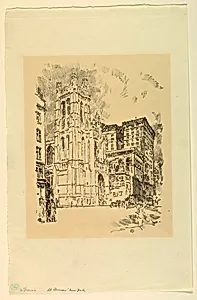
St. Thomas' New York
Classification
architecture
Department
Smithsonian Collection
Museum
Smithsonian American Art Museum
Credit
Smithsonian American Art Museum
Accession Number
1940-76-16
Rights
Public Domain
About this artwork
Research in Progress
Art Historical Context
Childe Hassam, a leading figure in American Impressionism (1859–1935), captured the vibrancy of early 20th-century New York in *St. Thomas' New* (1918). Known his luminous urban landscapes and flag series during World War I, Hassam often depicted the city's architectural landmarks with loose brushwork and vibrant light effects, blending European Impressionist techniques with distinctly American subjects. This work, classified as architecture, likely on the Gothic Revival splendor of St. Thomas Church Fifth Avenue, a symbol of New York's Gilded Age elegance. Created amid the final year of World War I, the painting reflects a moment of national reflection and resilience. Hassam's oeuvre from this period celebrated everyday patriotism and the enduring beauty of American cities, even as global conflict loomed. St. Thomas Church, completed in 1914, represented architectural ambition and spiritual continuity in a rapidly modernizing metropolis. Housed in the Smithsonian American Art Museum, *St. Thomas' New York* invites visitors to appreciate Hassam's masterful evocation of place—where stone facades glow with atmospheric color, bridging history and impressionistic innovation. Research continues to uncover more about its medium and creation, enriching our understanding of this iconic scene.