
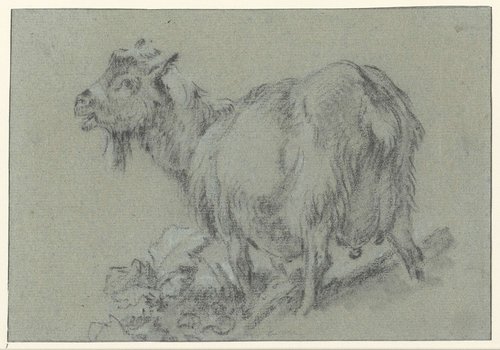
Staande geit
in or after 1767
Medium
paper
Dimensions
207; 134
Rights
Public Domain
About this artwork
zwart en wit krijt op blauw papier
Art Historical Context
"Staande geit" (Standing Goat) is a delicate chalk study created by the French artist Jean-Baptiste Huet after 1767. Huet, celebrated for his graceful animal depictions and Rococo-inspired designs, often produced such works as preparatory sketches for prints, textiles, or decorative panels. Rendered in black and white chalk on blue paper, the drawing measures just 134 by 207 millimeters, inviting viewers to appreciate its intimate scale and lively observation of the animal’s form. The choice of blue paper was a favored 18th-century technique that allowed artists to establish mid-tones quickly, using white chalk for highlights and black for shadows to achieve a sculptural sense of volume. Huet’s sure handling captures the goat’s alert posture and textured coat with economical strokes, demonstrating both his keen eye for natural detail and his skill in balancing realism with decorative elegance. Though modest in size, this sheet reflects the period’s growing interest in direct studies from nature, bridging Rococo playfulness with emerging Enlightenment attention to the animal world. It offers today’s visitors a charming glimpse into an artist’s working process and the refined draftsmanship of late-eighteenth-century France.