
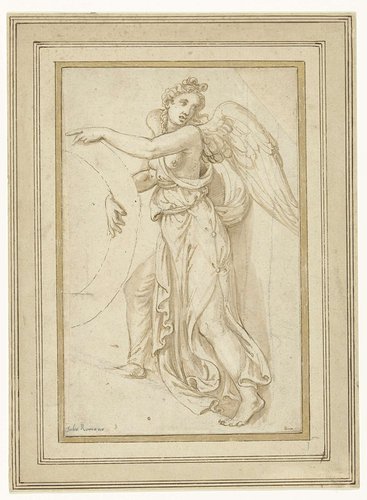
Staande Victoria
1525 - 1535
Medium
pen
Dimensions
260; 168
Rights
Public Domain
About this artwork
hoogte 260 mm x breedte 168 mm
Art Historical Context
**Staande Victoria** is a delicate pen drawing by Giulio Romano the eminent Italian Mannerist artist, created between 1525 and1535. Measuring just 260 mm high by 168 mm wide, intimate sheet captures a standing figure of Victoria, the Roman goddess of, rendered with Romano's characteristic elegance. Active during the transition from High Renaissance to Mannerism, Romano—once a favored pupil of Raphael—relocated to Mantua in 1524, where he served the Gonzaga court, producing innovative designs for frescoes, architecture, and decorative arts. The artwork exemplifies Romano's mastery of penwork, employing fluid, expressive lines to convey dynamic pose and draped drapery. Mannerism's hallmark distortions—elongated forms and graceful contrapposto—elevate the figure beyond classical ideals, infusing it with emotional intensity and sophistication. Such drawings often served as preparatory studies for larger commissions, showcasing Romano's improvisational genius. As a rare surviving sketch from his Mantuan period, *Staande Victoria* offers insight into the artistic process of a pivotal figure who influenced Baroque developments. Its precise technique and mythological subject reflect Renaissance humanism's blend of antiquity and invention, making it a gem for admirers of draftsmanship.
About the Artist
Giulio Romano · 1499–1546
Giulio Romano (c. 1499–1546) was the most gifted pupil of Raphael and one of the founding figures of Mannerism, the style that succeeded the High Renaissance in Italy. Born Giulio Pippi in Rome, he entered Raphael's workshop as a boy and proved so talented that by the time of Raphael's death in 1520 he was effectively running the studio and overseeing the completion of major unfinished commissions...