
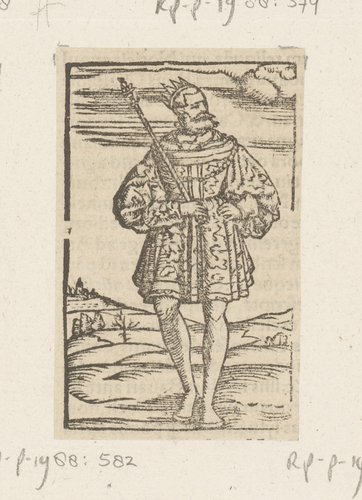
Staande vorst
1500 - 1599
Medium
paper
Dimensions
78; 49
Rights
Public Domain
About this artwork
height 78 mm x width 49 mm
Art Historical Context
**Staande Vorst (Standing Prince)** *Anonymous, 1500–1599, paper, 78 × 49 mm* This delicate anonymous artwork, titled *Staande Vorst* or "Standing Prince," dates to the 16th century—a vibrant era of the Northern Renaissance in the Low Countries, where Dutch and Flemish artists excelled in intricate details on modest scales. Rendered on paper and measuring just 78 by 49 millimeters (roughly the size of a modern credit card), it likely represents a preparatory drawing, miniature portrait, or study of a noble figure standing in regal poise. Such small works were prized for their portability, often used by artists in workshops for reference or by collectors as affordable tokens of prestige. The choice of paper as a medium highlights the technical innovations of the Renaissance, when high-quality rag paper enabled finer lines and shading techniques like hatching or stippling, common in anonymous prints or sketches from this period. While the artist's identity remains unknown—typical for many utilitarian or collaborative pieces—the depiction of a "vorst" (prince or ruler) evokes the era's fascination with sovereignty and hierarchy, possibly alluding to Habsburg rulers or local nobility amid the Dutch Revolt's early stirrings. Though enigmatic due to its anonymity, *Staande Vorst* offers a window into everyday Renaissance artistry: intimate, precise, and reflective of a time when even tiny images carried cultural weight, bridging elite patronage and broader artistic exchange. A charming gem for contemplating the unsung makers of history!