
Stacks of Wheat (End of Day, Autumn)
1890–91
Medium
Oil on canvas
Dimensions
65.8 × 101 cm (27 7/8 × 39 3/4 in.); Framed: 90.9 × 125.5 × 123.2 cm (35 3/4 × 49 3/8 × 48 1/2 in.)
Classification
oil on canvas
Department
Painting and Sculpture of Europe
Museum
Art Institute of Chicago
Accession Number
14624
Rights
Public Domain
About this artwork
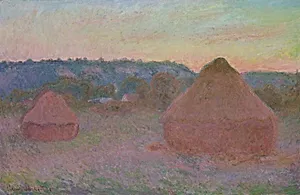
The monumental stacks that Claude Monet depicted in his series Stacks of Wheat rose fifteen to twenty feet and stood just outside the artist’s farmhouse at Giverny. Through 1890 and 1891, he worked on this series both in the field, painting simultaneously at several easels, and in the studio, refining pictorial harmonies. In May 1891, Monet hung fifteen of these canvases next to each other in one small room in the Galerie Durand-Ruel in Paris. An unprecedented critical and financial success, the...
Art Historical Context
Claude Monet's *Stacks of Wheat (End of Day, Autumn)*, painted between 1890 and 1891, is a captivating gem from his iconic Haystacks series. Created in the fields near his home in Giverny, France, this oil on canvas (65.8 × 101 cm) captures the simple beauty of wheat stacks at dusk during harvest season. As a cornerstone of Impressionism, Monet obsessively painted the same motif dozens of times, varying light, weather, and seasons to explore how perception shifts with nature's fleeting moments—a radical departure from academic realism. The artwork's significance lies in Monet's masterful use of broken brushstrokes and vibrant color to evoke atmosphere over precise detail. Warm oranges, golds, and purples blend in the fading autumn light, conveying the "end of day" glow that bathes the stacks in a harmonious, almost ethereal harmony. This technique exemplifies Impressionism's emphasis on *en plein air* painting, prioritizing sensory experience and optical effects. Housed in the Art Institute of Chicago's Department of Painting and Sculpture of Europe, this piece invites visitors to ponder Monet's enduring question: how does light transform the ordinary into the sublime? A must-see for anyone marveling at nature's daily drama.
About the Artist
Claude Monet · 1840–1926
Claude Monet, born Oscar-Claude Monet on November 14, 1840, in Paris and raised in Le Havre, Normandy, began his artistic journey as a successful teenage caricaturist. His formal training started at the Le Havre secondary school of the arts in 1851, where he received his first drawing lessons from Jacques-François Ochard. Around 1858, he met Eugène Boudin, who became his pivotal mentor, introducin...