
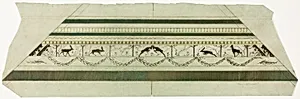
Stag and Flower Pattern Frame (bottom frame section)
1897–99
Medium
Etching and soft ground in black, yellow-brown metallic, and green-blue with plate tone, on ivory Japanese paper
Dimensions
Image/plate: 10.9 × 49.8 cm (4 5/16 × 19 5/8 in.); Sheet: 15.8 × 50 cm (6 1/4 × 19 11/16 in.)
Classification
etching
Department
Prints and Drawings
Museum
Art Institute of Chicago
Accession Number
211067
Rights
Public Domain
About this artwork
To display a set of nine color etchings, first exhibited in 1899, Roussel created two etched frame designs to cover wide wood moldings. The Stag and Flower Pattern Frame has an eclectic combination of design elements, while the Lotus Pattern Frame incorporates Egyptian motifs. The two etched frame designs were printed in distinct color combinations to complement specific color prints. The Stag and Flower frame segments are related to—but not the same as—two of those color variants.
Art Historical Context
Theodore Roussel's *Stag and Flower Pattern Frame (bottom frame section)* created between 1897 and 1899, exemplifies the late 19th-century revival of etching as a fine art medium. This intricate print, housed in the Art Institute of Chicago's Prints Drawings department, measures about 10.9 × 49.8 cm and showcases a decorative motif of a stag amid floral patterns. Roussel, a British artist influenced by James McNeill Whistler and the Aesthetic movement, specialized in elegant, tonal etchings that blurred the line between printmaking and painting. Roussel employed advanced techniques like etching and soft-ground etching in black, yellow-brown metallic, and green-blue inks, enhanced by plate tone for subtle depth and texture. Printed on luxurious ivory Japanese paper—prized for its absorbency and sheen—this choice reflects the era's Japonisme craze, where Western artists emulated Eastern aesthetics. The soft-ground method allowed for organic, flowing lines mimicking foliage and fur, making the frame section a harmonious blend of naturalism and ornamentation. As part of a larger frame design, this work highlights etching's potential for decorative luxury during the fin-de-siècle, bridging Art Nouveau's organic forms with technical innovation. Visitors will appreciate its meticulous craftsmanship, inviting closer inspection of its shimmering metallic hues and verdant palette.
About the Artist
Theodore Roussel · 1847–1926
Theodore Casimir Roussel was born on 23 March 1847 in Lorient, Brittany, France, into a naval family. After serving in the Franco-Prussian War, he began painting in 1872 as an entirely self-taught artist, initially rendering scenes of daily life in the meticulous style of the Old Masters. In 1878, he settled permanently in London, where he immersed himself in the vibrant British art scene. There, ...