
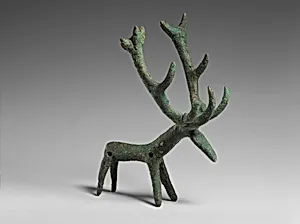
Stag figure
Unknown Artist
ca. early 1st millennium BCE
Medium
Bronze
Dimensions
4 3/16 × 1 7/8 × 3 1/8 in. (10.6 × 4.8 × 7.9 cm)
Classification
Metalwork-Sculpture
Culture & Period
Iran · Iron Age II
Department
Ancient Near Eastern Art
Museum
Metropolitan Museum of Art, New York, NY
Credit
Gift of Mrs. Khalil Rabenou, 1959
Accession Number
59.28
Rights
Public Domain
Tags
Art Historical Context
This exquisite bronze stag figure, crafted by an unknown artist around the early 1st BCE, captures the graceful form of a deer in miniature—measuring just 4 3/16 × 1 7/8 × 3 1/8 inches. H in the Metropolitan Museum of Art's Department of Ancient Near Eastern Art this Iron Age II artifact from Iran exemplifies the region's masterful metalwork traditions. Donated as a gift from Mrs. Khalil Raben in 1959, it invites us to marvel at the technical prowess of ancient artisans who cast such lifelike creatures from enduring bronze. During Iran's Iron Age II (roughly 1000–800 BCE), bronze sculpture flourished as a medium for expressing cultural and possibly ritual significance. Stags, like this one, often symbolized vitality, speed, and the wild forces of nature in Near Eastern iconography, appearing on horse fittings, votive offerings, or amulets. The solid bronze form suggests lost-wax casting, a sophisticated technique allowing intricate details such as the antlers' branching and the animal's poised stance, highlighting the era's blend of functionality and artistry. Though small, this stag stands as a window into a vibrant ancient world, where metalwork bridged daily life and the divine. Its survival through millennia speaks to bronze's resilience and the timeless allure of animal motifs in human creativity.