
Stage Design
1651 to 1700
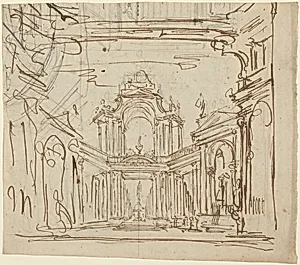
Medium
pen and brown ink over graphite on laid paper
Dimensions
overall: 21 x 24 cm (8 1/4 x 9 7/16 in.)
Classification
Drawing
Department
CG-E
Museum
National Gallery of Art, Washington, D.C.
Credit
Gift of Gaillard F. Ravenel and Frances P. Smyth-Ravenel
Accession Number
2000.7.19.a
Rights
Public Domain
Art Historical Context
This delicate *Stage Design*, created by an anonymous Italian artist between 1651 1700, offers a glimpse into the grandeur of Baroque theater. Rendered on a modest sheet of laid paper measuring just 21 x 24 cm, it captures the architectural fantasy typical of Italy's vibrant opera and dramatic stages during the late 17th century. Such designs were essential for transforming theaters into immersive worlds, employing dramatic perspective to evoke palaces, gardens, or mythical realms for audiences in cities like Venice and Rome. The artwork's medium—graphite underdrawing refined with pen and brown ink—highlights the precision of preparatory sketches from this era. Graphite provided a subtle base for planning complex spatial illusions, while the fluid brown ink lines added depth and movement, a technique favored by scenic architects to convey light and shadow on stage. Laid paper, with its textured chains and wires from handmade production, was the standard support for such works, preserving fine details over centuries. Now housed in the National Gallery of Art thanks to a generous gift from Gaillard F. Ravenel and Frances P. Smyth-Ravenel, this drawing exemplifies the ingenuity of Italian stagecraft, bridging art and performance in an age of spectacle and innovation.