
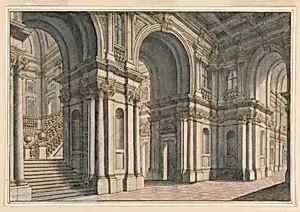
Stage Design: Palace Interior
Medium
theater
Classification
theater
Department
Smithsonian Collection
Museum
Smithsonian American Art Museum
Credit
Museum purchase through gift of various donors and from Eleanor G. Hewitt Fund
Accession Number
1938-88-49
Rights
Public Domain
About this artwork
Research in Progress
Art Historical Context
Step into the grandeur of 18th-century European theater with *Stage Design: Palace Interior* Francesco Galli Bibiena1659–1739), a master of Baroque scenic architecture from Italy. Created between 1700 and 1750, this evocative design captures the opulent illusion of a lavish palace hall, intended for opera houses and royal courts where spectacle was paramount. Bibiena, part of the illustrious Bibiena family dynasty of designers, revolutionized stagecraft with his innovative "scena per" technique—a diagonal perspective that created breathtaking depth and dynamism on flat stages. As a theatrical gouache or drawing (typical of the medium), this work exemplifies how stage designs were not mere sketches but architectural blueprints for immersive worlds. They brought mythological tales and heroic dramas to life, blending architecture, painting, and engineering to fool the eye into infinite space. Bibiena's designs graced venues from Bologna to Vienna, influencing opera productions and court entertainments during the height of absolutist monarchies. Housed in the Smithsonian American Art Museum through a generous museum purchase, this piece invites us to appreciate theater's power as visual poetry. Though research continues, it stands as a testament to the artistry that made Baroque stages magical gateways to fantasy. (198 words)