
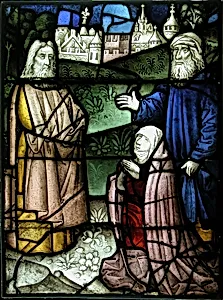
Stained Glass Panel with a Holy Man and Two Suppliants
Unknown Artist
15th century
Medium
Pot metal, white glass, vitreous paint, silver stain
Dimensions
Overall: 30 1/4 x 22 1/2 x 1/4 in. (76.8 x 57.2 x 0.6 cm)
Classification
Glass-Stained
Culture
South Netherlandish
Department
Medieval Art
Museum
Metropolitan Museum of Art, New York, NY
Credit
Bequest of George D. Pratt, 1935
Accession Number
41.170.98
Rights
Public Domain
Art Historical Context
This exquisite 15th-century stained panel from the South Netherlands a poignant moment of devotion: a holy man, likely a saint, flanked by two suppliants kneeling in prayer. Crafted during the late Gothic period, it exemplifies the region's mastery of stained glass, a medium that transformed church windows into radiant narratives. Originally part of a larger ecclesiastical ensemble, such panels bathed medieval worshippers in jewel-toned light, symbolizing divine illumination. Artisans employed sophisticated techniques including pot metal glass—dense, colored sheets—for the vivid reds, blues, and greens; white glass for flesh tones; vitreous paint for fine black-line details; and innovative silver stain, which fired gold-yellow hues directly into the glass surface. This allowed for more naturalistic effects without bulky lead supports, marking a technical leap in the 15th century that enhanced storytelling and realism. Housed in the Metropolitan Museum of Art through the bequest of George D. Pratt in 1935, this South Netherlandish treasure reflects the era's spiritual fervor, where art served both education and piety for illiterate congregations. Its survival offers a glimpse into the luminous world of Gothic devotion.