
Staircase Lobby Design
19th century
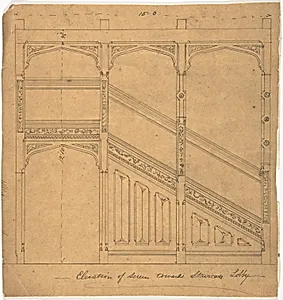
Medium
Pen and ink on tracing paper
Classification
Drawings|Ornament & Architecture
Department
Drawings and Prints
Museum
Metropolitan Museum of Art, New York, NY
Credit
The Elisha Whittelsey Collection, The Elisha Whittelsey Fund, 1960
Accession Number
60.632.185
Rights
Public Domain
Tags
Art Historical Context
Nestled within the Metropolitan Museum of Art Elisha Whittelsey Collection, thisStaircase Lobby Design is a delicate pen and ink drawing on tracing paper by an anonymous artist from the 19th century.ed with precise lines, it captures the ornate details of a grand staircase lobby, showcasing the era's fascination with architectural ornamentation. The translucent tracing paper was a practical choice for draftsmen, allowing overlays for refinements or copies—essential in an age before modern reproduction tools. In Victorian Britain, such drawings were vital blueprints for public and private spaces, blending functionality with aesthetic grandeur. This piece reflects the period's architectural trends, where staircases served as dramatic focal points in homes and institutions, often embellished with elaborate railings, balustrades, and decorative motifs. Pen and ink's fine control enabled meticulous shading and patterning, highlighting the designer's skill in evoking depth and texture on a fragile surface. Acquired through The Elisha Whittelsey Fund in 1960, this anonymous gem offers a window into 19th-century design practices, inviting us to appreciate the unsung artistry behind Britain's built heritage. Though unattributed, its survival underscores the enduring value of architectural sketches in preserving cultural aspirations.
About the Artist
Anonymous, British, 19th century · 1800–1900
**Anonymous, British, 19th century** is not the name of a single individual but a standard museum attribution used for works whose creators remain unidentified yet are clearly British and date to the 1800s. Major institutions, including the Metropolitan Museum of Art, employ this designation for hundreds of drawings, prints, designs, and decorative studies that lack signatures or firm documentary ...