
Stamp, Monkey
Unknown Artist
14th–early 16th century
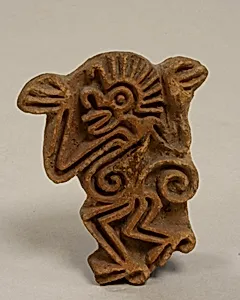
Medium
Ceramic
Dimensions
W. 2 × D. 5/8 × L. 2 1/2 in. (5.1 × 1.6 × 6.4 cm)
Classification
Ceramics-Implements
Culture
Aztec
Department
Arts of Africa, Oceania, and the Americas
Museum
Metropolitan Museum of Art, New York, NY
Credit
Museum Purchase, 1900
Accession Number
00.5.1164
Rights
Public Domain
Tags
About this artwork
This ceramic stamp depicting a monkey dates from the 14th to early 16th century and exemplifies the sophisticated small-scale ceramic production of the Aztec civilization in Mesoamerica. Measuring approximately 2 by 2½ inches, the stamp was used to apply decorative patterns to cloth, paper, or human skin, serving both aesthetic and possibly ritual purposes. Aztec artisans excelled in ceramic work, producing everything from monumental sculptures to delicate utilitarian objects. The monkey held sp...
Art Historical Context
This charming ceramic stamp, titled *Stamp, Monkey*, hails from the Aztec civilization of Mesoamerica, crafted between the 14th and 16th centuries. just 2 by 2½ inches, it exemplifies the Aztecs' mastery of small-scale ceramics, used to imprint intricate patterns onto cloth, paper, or human skin for decorative or ritual purposes. Aztec artisans produced a vast array of ceramics, from grand sculptures to everyday tools like this one, showcasing their skill in molding and firing clay to create durable, detailed objects. The monkey motif carries deep cultural weight in Mesoamerican cosmology, symbolizing arts, dance, and playful mischief, often featured in myths. These stamps democratized sophisticated designs, allowing complex motifs to be repeated beyond elite workshops. Its survival over five centuries highlights the resilience of ceramic artifacts and the reverence for Aztec craftsmanship. Acquired by the Metropolitan Museum of Art in 1900 through a museum purchase, this unassuming implement reflects early 20th-century fascination with pre-Columbian art. It reminds visitors that true artistic brilliance thrives in the intimate details of daily life, not just monumental works.