
Stamp seal
Unknown Artist
ca. late 4th century CE
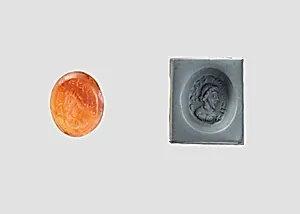
Medium
Carnelian
Dimensions
0.39 x 0.16 x 0.51 in. (0.99 x 0.41 x 1.3 cm)
Classification
Stone-Stamp Seals-Inscribed
Culture & Period
Sasanian · Sasanian
Department
Ancient Near Eastern Art
Museum
Metropolitan Museum of Art, New York, NY
Credit
Gift of John Taylor Johnston, 1881
Accession Number
81.6.279
Rights
Public Domain
About this artwork
This carnelian stamp seal represents the sophisticated seal-carving traditions of the Sasanian Empire, which ruled Persia and Mesopotamia from the 3rd to 7th centuries CE. Dating to approximately the late 4th century CE, this diminutive object—less than half an inch in its largest dimension—served crucial administrative and personal functions. Stamp seals were pressed into clay or wax to authenticate documents, secure containers, and mark ownership. The Sasanian period witnessed a florescence of...
Art Historical Context
This exquisite carnelian stamp seal crafted in the late 4th century CE during the Sasanian Empire's age, exemplifies the pinnacle of ancient Near Eastern glyptic art. Ruling Persia and Mesopotamia from the 3rd to 7th centuries CE, theanians produced these tiny masterpieces—measuring just 0. x 0.16 x 0.51 inches essential daily use. Pressed into clay or wax, authenticated documents, sealed containers, and marked ownership blending practicality with prestige. Carved in intaglio from prized translucent reddish carnelian, the seal's hardness deterred forgeries while showcasing the carver's virtuosity. Using only simple tools and abrasives, artisans achieved astonishing detail at miniature scale, often incorporating royal figures, Zoroastrian symbols, or Pahlavi inscriptions—possibly including male profiles here. Such seals were status symbols, reflecting the owner's rank in a society that revered technical mastery. A gift to the Metropolitan Museum of Art from John Taylor Johnston in 1881, this seal anchors the museum's early Sasanian collection, offering a window into an empire's sophisticated bureaucracy and enduring artistic legacy.