
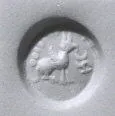
Stamp seal
Unknown Artist
ca. 5th–7th century CE
Medium
Stone
Dimensions
0.35 in. (0.89 cm)
Classification
Stone-Stamp Seals
Culture & Period
Sasanian · Sasanian
Department
Ancient Near Eastern Art
Museum
Metropolitan Museum of Art, New York, NY
Credit
Gift of Martin and Sarah Cherkasky, 1986
Accession Number
1986.311.15
Rights
Public Domain
Tags
Art Historical Context
This exquisite stamp seal, crafted from stone during the Sasanian period (ca. 5th–7th century CE), hails from the vibrant culture of ancient Iran under the Sasanian Empire of the last great Persian dynasties before the Islamic conquest. Measuring just 0.35 (0.89 cm) in diameter, this tiny artifact exemplifies the precision of Sasanian stone carving, a technique honed for creating intricate impressions on clay or wax. Belonging to the Metropolitan Museum of Art's Ancient Eastern Art collection, it generously gifted by Martin and Sarah Cherky in 1986. Stamp seals like this were essential tools in everyday Sasanian life, used for sealing documents, goods, and containers to denote ownership, authenticity, or authority. Their designs often featured animals—a tag highlighting this seal's probable motif—reflecting the empire's fascination with wildlife, mythology, and royal symbolism. Sasanian art blended Persian traditions with influences from neighboring regions, showcasing a sophisticated style that emphasized symmetry, dynamic forms, and narrative depth in miniature formats. Though small, this seal offers a window into a bustling empire known for its administrative prowess, Zoroastrian faith, and artistic innovation. Visitors can marvel at how such a modest object bridged art, bureaucracy, and culture in the ancient Near East.