
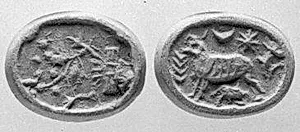
Stamp seal (bifacial disk) with animals and divine symbols
Unknown Artist
7th century BCE
Medium
Steatite, brown
Dimensions
Seal Face: 1.97 x 1.48 cm Height: 0.85 cm String Hole: 0.3 cm
Classification
Stone-Stamp Seals
Culture & Period
Assyrian · Neo-Assyrian
Department
Ancient Near Eastern Art
Museum
Metropolitan Museum of Art, New York, NY
Credit
Purchase, 1899
Accession Number
99.22.45
Rights
Public Domain
Tags
Art Historical Context
This exquisite bifacial disk stamp seal, crafted from brown steatite in the Neo-Assyrian period around the 7th century BCE, measures just 1.97 x 1.48 cm across its face—small enough to fit in your palm. Produced by an unknown Assyrian artisan, both sides are intricately engraved with animals and divine symbols, including crescents, evoking the sacred motifs of ancient Mesopotamian cosmology. A central string hole (0.3 cm) allowed it to be worn as an amulet or strung onto documents, blending practicality with protective magic. In the powerful Neo-Assyrian Empire, which dominated the Near East from modern-day Iraq to Egypt, such seals were essential tools for imprinting clay with personal or official marks, denoting ownership, authority, or divine favor. Steatite's soft, soapstone-like quality made it ideal for fine carving with drills and burins, enabling the detailed rendering of dynamic animals—perhaps lions or bulls—and celestial emblems like the moon, linked to the god Sin. These symbols warded off evil and invoked prosperity. Today, this tiny treasure from the Metropolitan Museum of Art's Ancient Near Eastern collection (purchased in 1899) offers a window into Assyrian daily life and artistry, where even miniature objects pulsed with cosmic significance. Marvel at its precision: a testament to a civilization's mastery of form and faith.