
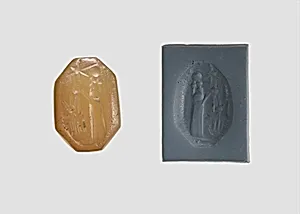
Stamp seal (octagonal pyramid) with cultic scene
Unknown Artist
7th–6th century BCE
Medium
Neutral Chalcedony (Quartz)
Dimensions
Seal Face: 1.97 x 1.33 cm Height: 2.59 cm String Hole: 0.3 cm
Classification
Stone-Stamp Seals
Culture & Period
Assyro-Babylonian · Neo-Assyrian / Neo-Babylonian
Department
Ancient Near Eastern Art
Museum
Metropolitan Museum of Art, New York, NY
Credit
Purchase, 1893
Accession Number
93.17.64
Rights
Public Domain
Art Historical Context
This exquisite stamp seal, carved from neutral chalcedony—a durable variety of quartz prized for its fine grain and ability to hold intricate details—dates to the 7th–6th BCE, during the Neo-Assyrian and Neoabylonian periods. Shaped as a diminutive octagonal pyramid ( 1.97 x 1.33 cm at the face and 2.59 cm tall), it features a cultic scene on its base, likely depicting deities or ritual figures central to Mesopotamian worship. Produced by an unknown artist in the Assyro-Babylonian tradition, such seals were everyday tools of power and piety in ancient Near Eastern society. Stamp seals like this one were pressed into soft clay to create impressions, serving as personal signatures on documents, goods, or door sealings—much like a modern stamp. The shift from earlier cylinder seals to pyramidal stamp forms in this era reflects evolving artistic preferences and practical needs in the vast empires of Assyria and Babylon, where bureaucracy and religion intertwined. The cultic imagery underscores the era's deep spiritual life, invoking protection from gods amid conquests and kings like Nebuchadnezzar II. Though tiny, the seal's precision carving highlights masterful lapidary techniques, with a 0.3 cm string hole suggesting it was worn as an amulet. Acquired by the Metropolitan Museum of Art in 1893, it offers a tangible glimpse into a world of divine kingship and daily devotion.