
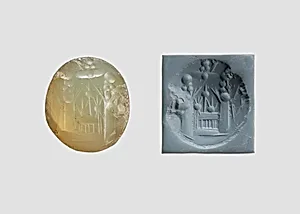
Stamp seal (oval conoid) with cultic scene
Unknown Artist
7th century BCE
Medium
Flawed neutral Agate (Quartz)
Dimensions
Seal Face: 2.35 x 2.09 cm Height: 2.92 cm String Hole: 0.25 cm
Classification
Stone-Stamp Seals
Culture & Period
Assyrian · Neo-Assyrian
Department
Ancient Near Eastern Art
Museum
Metropolitan Museum of Art, New York, NY
Credit
Purchase, 1893
Accession Number
93.17.78
Rights
Public Domain
Art Historical Context
This exquisite oval conoid stamp seal carved from flawed neutral agate—a durable variety of quartz—offers a glimpse into the Neo-Assyrian world of the 7th century BCE. just 2.35 x 2.09 cm on its seal face and standing 2.92 cm tall, this tiny artifact was designed to be worn on a string (hole diameter 0.25 cm) and into soft clay to leave an impression. Its intimate scale belies its practical power: seals like this authenticated documents, marked property, and sealed transactions across the vast Assyrian Empire. The engraved cultic scene on its face captures a ritual moment, likely involving deities or sacred figures central to Assyrian worship. During the Neo-Assyrian period (911–609 BCE), such seals blended administrative utility with profound religious symbolism, reflecting a society where kings ruled as divine agents and temples pulsed with elaborate ceremonies. Artisans expertly incised fine details into the hard stone using drills and abrasives, showcasing technical mastery despite the material's natural flaws. Acquired by the Metropolitan Museum of Art in 1893, this seal endures as a testament to Assyrian artistry and piety, bridging the ancient Near East's spiritual life with our modern curiosity.