
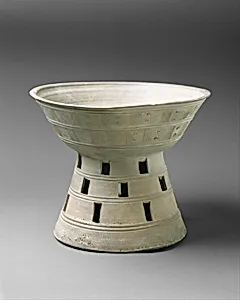
그릇받침 삼국, 신라|器臺 三國, 新羅|Stand with perforated base
Unknown Artist
5th–6th century
Medium
Stoneware with traces of ash glaze
Dimensions
H. 13 in. (33 cm) Diam. of rim: 16 1/4 in. (41.3 cm) Diam. of foot: 12 in. (30.5 cm)
Classification
Ceramics
Culture & Period
Korea · Three Kingdoms period, Silla Kingdom (57 B.C.–A.D. 676)
Department
Asian Art
Museum
Metropolitan Museum of Art, New York, NY
Credit
Purchase, Lila Acheson Wallace Gift, 1997
Accession Number
1997.34.21
Rights
Public Domain
Art Historical Context
Step into the vibrant world of Korea with this striking *Stand with Perforated Base* from Silla Kingdom, one of the Three Kingdoms that shaped the Korean peninsula from the 1st century B.C. to the 7th century A.D. Crafted in the 5th–6th, this stoneware vessel stands 13 inches tall with a wide rim (16¼ inches in diameter) and a sturdy foot (12 inches across). Its perforated base—a series of holes cleverly integrated into the design—suggests it served as a practical support for bowls or dishes, allowing steam or liquids to drain away during use. Made from durable stoneware and bearing faint traces of ash glaze, this piece highlights early mastery of high-fired ceramics in Silla, where potters achieved vitrified surfaces through wood-ash firing in kilns. Ash glazes, created naturally from kiln vapors, lent a subtle, earthy luster that was both functional and aesthetically pleasing. Such techniques marked a pivotal shift from earthenware to more refined stoneware, reflecting Silla's growing technical sophistication amid cultural flourishing. Housed in the Metropolitan Museum of Art's Asian Art Department (purchase, Lila Acheson Wallace Gift, 1997), this stand offers a window into everyday life and ritual in Three Kingdoms-era Korea. It embodies the ingenuity of anonymous artisans whose work laid the foundation for Korea's enduring ceramic tradition, blending utility with subtle elegance.