
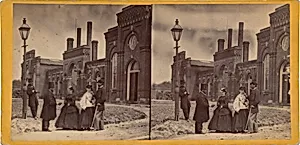
Standard Petroleum Refinery, Pittsburg, Pennsylvania
c. 1865
Medium
stereoscopic albumen prints
Dimensions
image/sheet (each): 7.8 × 7.9 cm (3 1/16 × 3 1/8 in.) mount: 8.2 × 17.1 cm (3 1/4 × 6 3/4 in.)
Classification
Photograph
Department
CPH
Museum
National Gallery of Art, Washington, D.C.
Credit
Pepita Milmore Memorial Fund
Accession Number
2017.93.1
Rights
Public Domain
Art Historical Context
This striking stereoscopic photograph captures the Standard Petroleum Refinery in Pittsburgh, Pennsylvania, around 1865, at a pivotal moment when the American oil industry was rapidly transforming the nation’s economy and landscape. Created by photographer Thomas H. Johnson as a pair of albumen prints mounted side by side, the image was designed to be viewed through a stereoscope, producing a vivid three-dimensional effect that brought industrial scenes to life for armchair travelers of the era. Albumen prints, made using egg-white emulsions on paper, were the dominant photographic process of the mid-nineteenth century, prized for their fine detail and tonal richness. Johnson’s choice of the stereoscopic format reflects the period’s fascination with new optical technologies that could convey depth and realism, turning an ordinary factory view into an immersive experience. Such images helped shape public understanding of industrialization, documenting the growth of refineries that would fuel America’s expansion while revealing both the promise and the environmental scale of this emerging industry. Today the work resides in the National Gallery of Art’s collection as an important record of early industrial photography. Its modest size belies the way it compresses vast economic change into a single, engaging visual experience for modern viewers.
About the Artist
Thomas H. Johnson · 1860–1870
Thomas H. Johnson was an American artist active in the latter half of the nineteenth century. Working during a period of considerable vitality in American art — when landscape painting, genre scenes, and printmaking were all flourishing — Johnson contributed to a visual culture that was expanding rapidly alongside the nation itself. The specifics of Johnson's training are not fully documented, th...