
Standard support
Unknown Artist
ca. 8th–7th century BCE
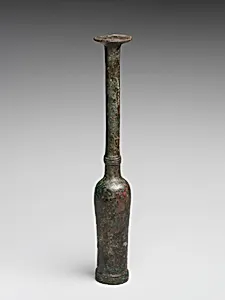
Medium
Bronze
Dimensions
7 × 1 × 1 in. (17.8 × 2.5 × 2.5 cm)
Classification
Metalwork-Sculpture
Culture & Period
Iran · Iron Age III
Department
Ancient Near Eastern Art
Museum
Metropolitan Museum of Art, New York, NY
Credit
Gift of George D. Pratt, 1932
Accession Number
32.161.15
Rights
Public Domain
Art Historical Context
### Standard Support *ca. 8th–7th century BCE,, Iran, Iron Age III* delicate bronze *Standard support* from ancient Iran invites us into the Iron Age III period (ca. 800–550 BCE), a time when powerful kingdoms like the Medes were rising in the Zagros Mountains. Measuring just 7 × 1 × 1 inches, this small yet intricately crafted object likely served as a base or mount for a ceremonial—a pole topped with symbolic figures carried in processions, battles, or rituals. Such artifacts highlight the region's growing mastery of bronze casting, where molten metal was poured into molds to create durable, portable emblems of status and power. Bronze metalwork like this exemplifies the technical prowess of ancient Iranian artisans, who alloyed copper and tin for strength and shine. In the Ancient Near East, these objects bridged the practical and the sacred, possibly supporting banners with animal motifs or divine symbols that rallied tribes or honored deities. Donated to the Metropolitan Museum of Art in 1932 by George D. Pratt, it offers a tangible link to a formative era before the Achaemenid Empire's grandeur. Though its exact form remains enigmatic without further decoration preserved, this piece underscores Iran's pivotal role in early metallurgy and cultural exchange across Mesopotamia and beyond. A quiet testament to forgotten hands shaping history.