
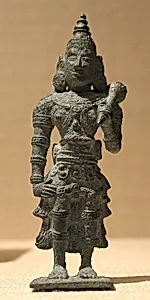
Standing Attendant with a Fly Whisk
Unknown Artist
ca. 14th century
Medium
Bronze
Dimensions
H. 4 1/4 in. (10.8 cm); W. 1 1/2 in. (3.8 cm); D. 1 3/8 in. (3.5 cm)
Classification
Sculpture
Culture & Period
Sri Lanka · Divided Kingdoms period (1232–1597)
Department
Asian Art
Museum
Metropolitan Museum of Art, New York, NY
Credit
Gift of Iuliana and Mark Phillips, 1991
Accession Number
1991.458.2
Rights
Public Domain
Tags
Art Historical Context
This delicate bronze sculpture, *Standing Attendant with a Fly Whisk*, hails from Sri Lanka during the Divided Kingdoms period (2–1597), dated to the 14th. Standing just 4¼ inches tall, the figure captures a poised male attendant, likely from a royal or temple court, holding a fly whisk—a traditional symbol of service and vigilance. Crafted in bronze, a favored medium for durable religious and secular art in medieval Sri Lanka, it exemplifies island's sophisticated metalworking traditions amid political fragmentation following the Polonnaruwa's decline. The Divided Kingdoms era saw rival dynasties vying for power in regions like Kotte and Kandy, fostering vibrant artistic patronage tied to Buddhism and Hinduism. Such attendant figures often flanked larger deities or monarchs in shrines, their alert stance and ritual implement underscoring themes of devotion and hierarchy. The sculpture's compact scale suggests it may have adorned a private altar or processional icon, highlighting the portability and intimacy of Sri Lankan bronzes. Bronze casting techniques, probably lost-wax, allowed for intricate details like the attendant's draped garments and serene expression, blending Indian influences with local stylistic grace. Gifted to the Metropolitan Museum of Art in 1991, this piece invites visitors to ponder the everyday guardians of sacred spaces in ancient Sri Lanka.