
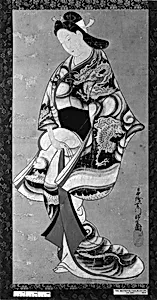
Standing Beauty
Medium
Matted painting; ink and color on paper
Dimensions
Overall: 25 5/8 x 12 13/16 in. (65.1 x 32.5 cm) Image: 23 7/16 x 11 3/8 in. (59.5 x 28.9 cm) Mat: 29 3/8 x 17 1/4 in. (74.6 x 43.8 cm)
Classification
Paintings
Culture & Period
Japan · Edo period (1615–1868)
Department
Asian Art
Museum
Metropolitan Museum of Art, New York, NY
Credit
H. O. Havemeyer Collection, Bequest of Mrs. H. O. Havemeyer, 1929
Accession Number
29.100.454
Rights
Public Domain
Tags
Art Historical Context
Hishikawa Moron's *Standing Beauty* is a captivating example of Edo-period Japanese painting, rendered in ink and color on paper. Created during the vibrant 17th-19th century Edo period (1615–1868), this matted hanging scroll measures about 25⅝ × 12⅞ inches overall, showcasing the artist's mastery in depicting elegant female figures. Moronobu (active ca. 1670s–1690s), one of the earliest pioneers of ukiyo-e—"pictures of the floating world"—excelled in both woodblock prints and paintings, bringing the fleeting pleasures of urban life to life with fluid lines and vivid hues. The work features a poised woman, likely a beauty from the Yoshiwara pleasure district, accompanied by dynamic dragon motifs that evoke power, auspiciousness, and the supernatural in Japanese lore. Dragons, symbols of imperial might and rain-bringing benevolence, add a layer of mythical grandeur to the intimate portrayal of femininity. Moronobu's technique employs delicate ink washes and subtle color layering on paper, creating a sense of graceful movement and three-dimensionality rare in early ukiyo-e paintings. Part of the renowned H. O. Havemeyer Collection at The Metropolitan Museum of Art, this piece highlights the global appreciation for Japan's artistic legacy, inviting viewers to ponder the interplay of beauty, nature, and fantasy in Edo culture.
About the Artist
Hishikawa Moronobu 菱川師宣 (Japanese) · 1618 –1694
Japanese, 1618–1694