
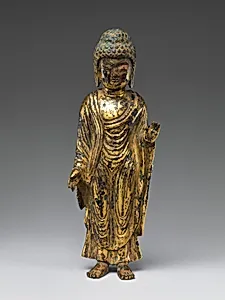
금동여래입상 통일신라 |金銅如來立像 統一新羅|Standing Buddha
Unknown Artist
8th century
Medium
Gilt bronze
Dimensions
H. 6 3/4 in. (17.1 cm)
Classification
Sculpture
Culture & Period
Korea · South and North Kingdoms period (676–935), Unified Silla
Department
Asian Art
Museum
Metropolitan Museum of Art, New York, NY
Credit
Rogers Fund, 1917
Accession Number
17.118.53
Rights
Public Domain
Tags
Art Historical Context
This exquisite *Standing Buddha* (금동여래입상 crafted in the 8th century during Korea's Unified Silla period676–935), stands a luminous testament to the era's artistic and spiritual zenith. Measuring just 6 3/4 inches (17.1 cm) high, this gilt bronze sculpture captures the Tathagata (Yeorae), the "Thus Come One," in a poised standing posture typical of Buddhist icons from this golden age of Korean unification. Acquired through the Rogers Fund in 7, it now graces the Metropolitan Museum of Art Asian Art department. Gilt bronze was a prized medium in Unified Silla, where artisans mastered sophisticated lost-wax casting and fire-gilding techniques to sheath bronze cores in a radiant gold layer, symbolizing the Buddha's divine glow and imperishability. Buddhism, deeply embedded in Silla society as a state-supported faith, inspired such portable masterpieces for personal devotion, temple shrines, or royal patronage. This small-scale work reflects the period's refined aesthetic—elegant proportions and serene tranquility—highlighting Korea's mastery in blending technical innovation with profound religious expression. Visitors will appreciate how this sculpture bridges art and spirituality, embodying the harmonious ideals of enlightenment amid Silla's cultural flourishing. A true treasure from ancient Korea!