
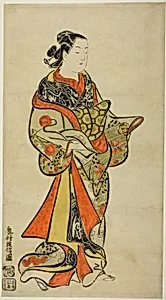
Standing Courtesan
1710s
Medium
Hand-colored woodblock print; o-oban, sumizuri-e
Dimensions
54 × 29.3 cm (21 5/16 × 11 9/16 in.)
Classification
woodblock print
Department
Arts of Asia
Museum
Art Institute of Chicago
Accession Number
19189
Rights
Public Domain
Art Historical Context
**Standing Courtesan** Okumura Masan, created in the 1710s, captures the elegance of Edo-period Japan's "floating world" (ukiyo-e), where urban pleasures like theater and courtesans reigned supreme. This striking hand-colored woodblock print depicts a poised courtesan in lavish robes, her fan and kimono folds evoking the fashionable Yoshiwara pleasure district in Edo (modern Tokyo). Masanobu a pioneering ukiyo artist, blended realism with stylized beauty, making figures like this one both aspirational and accessible to a growing merchant class audience. Printed in the large o-oban format (54 × 29.3 cm), this sumizuri-e—a black ink print meticulously hand-colored afterward—highlights early 18th-century innovations in woodblock techniques. Before full-color nishiki-e prints emerged, artists like Masanobu used subtle hues to bring vibrancy to monochrome blocks, showcasing exquisite control over line work and pigmentation. Held in the Art Institute of Chicago's Arts of Asia department, it exemplifies how ukiyo-e democratized art, transforming everyday woodblocks into collectible treasures. This piece offers a window into Japan's Genroku-era cultural bloom, where courtesans symbolized refined sensuality amid social flux. Its preserved colors and dynamic pose reveal Masanobu's influence on later masters like Utamaro, inviting visitors to ponder the artistry behind fleeting beauty.
About the Artist
Okumura Masanobu · 1686–1764
Japanese, 1686–1764