
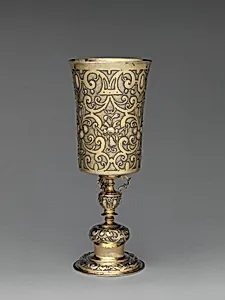
Standing cup
Unknown Artist
early 17th century
Medium
Gilded silver
Dimensions
Overall: 9 1/16 x 3 5/8 in. (23 x 9.2 cm)
Classification
Metalwork-Silver
Culture
possibly Hungarian
Department
European Sculpture and Decorative Arts
Museum
Metropolitan Museum of Art, New York, NY
Credit
Gift of The Salgo Trust for Education, New York, in memory of Nicolas M. Salgo, 2010
Accession Number
2010.110.11
Rights
Public Domain
Art Historical Context
Step into the opulent world of 17th-century European metalwork with this exquisite *Standing Cup*, crafted by an unknown artist in the 1600s. Measuring a delicate 9 1/16 x 3 5/8 inches, this gilded silver vessel exemplifies the era's mastery of luxury craftsmanship. The gilding technique—applying a thin layer of gold over—created a radiant, jewel-like finish that shimmered under candlelight, reserved for the elite who used such cups in grand banquets or as status symbols on display. Possibly of Hungarian origin, the cup reflects the cultural crossroads of Central Europe during a time of political flux under Habsburg influence and Ottoman pressures. Silver metalwork like this was not just functional but a canvas for artistic virtuosity, showcasing intricate chasing, engraving, or repoussé techniques typical of the period's decorative arts. Its standing form, with a sturdy foot and elegant proportions, ensured both stability and visual drama. Today, this treasure graces the Metropolitan Museum of Art's European Sculpture and Decorative Arts department, a generous gift from The Salgo Trust in 2010. It invites us to ponder the hands that fashioned it and the lavish lives it adorned, bridging centuries with its timeless gleam.