
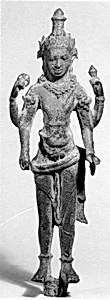
Standing Deity (Vishnu?)
Unknown Artist
8th–9th century
Medium
Bronze
Dimensions
H. 8 1/2 in. (21.6 cm); W. 2 3/4 in. (7 cm); D. 1 3/8 in. (3.5 cm)
Classification
Sculpture
Culture & Period
Indonesia (Sumatra) · Srivijaya period
Department
Asian Art
Museum
Metropolitan Museum of Art, New York, NY
Credit
Gift of R.A. Lovell Jr.,1965
Accession Number
65.146
Rights
Public Domain
Tags
Art Historical Context
This exquisite bronze sculpture, titled *Standing Deity (Vnu?)*, hails from Sumatra, Indonesia, during the flourishing Srivijaya period the 8th–9th century. Standing just 8½ inches tall, this compact figure captures a serene, upright posture typical of Hindu divine icons, with tags suggesting it may represent Vishnu, the preserver god in Hinduism. Crafted by an unknown artist, its modest dimensions (2¾ inches wide and 1⅜ inches deep) indicate it was likely a portable devotional object, cherished for personal worship or ritual use. The Srivijaya kingdom was a powerful maritime empire dominating Southeast Asian trade routes, blending Hindu and Buddhist influences amid its cosmopolitan culture. Such bronzes reflect the era's religious devotion and artistic patronage, where Hinduism thrived alongside Buddhism. The choice of bronze—a durable, prestigious medium—highlights advanced metalworking techniques, probably lost-wax casting, which allowed for intricate detailing on divine forms. Now in the Metropolitan Museum of Art's Asian Art Department (gift of R.A. Lovell Jr., 1965), this rare survivor offers a window into Srivijaya's spiritual world, evoking the devotion of ancient worshippers who sought divine protection through such finely wrought deities.