
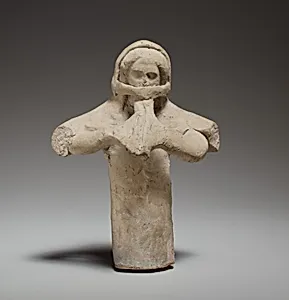
Standing female flute player
Unknown Artist
late 5th–early 4th century BCE
Medium
Terracotta
Dimensions
H. 4 1/16 in. (10.3 cm)
Classification
Terracottas
Culture & Period
Cypriot · Late Cypro-Classical I–Early Cypro-Classical I
Department
Greek and Roman Art
Museum
Metropolitan Museum of Art, New York, NY
Credit
The Cesnola Collection, Purchased by subscription, 1874–76
Accession Number
74.51.1689
Rights
Public Domain
Tags
Art Historical Context
This delicate terracotta figurine, *Standing Female Flute Player hails from Cyprus during the Late Cyproical I–Early Cy-Classical II period (late 5th–early 4th century BCE Standing just over 4 inches tall, it captures a graceful woman in mid-performance, her fingers poised on a double flute—an instrument central to ancient music-making. Crafted by an unknown artist, this small votive or decorative object exemplifies the terracotta tradition of Cypriot workshops, where molds and hand-modeling created affordable, mass-produced figures for homes, sanctuaries, and tombs. In Cypriot culture, such figurines offer a window into daily life and ritual practices, highlighting the prominent role of women as musicians. Flutes like the one depicted were likely used in religious ceremonies, banquets, or festivals, blending Greek influences with local traditions amid Cyprus's strategic position in the Mediterranean. The Cesnola Collection at The Metropolitan Museum of Art, acquired through 19th-century subscriptions, preserves this piece as a testament to Cyprus's vibrant artistic output during a time of cultural exchange. Its modest size and earthy medium underscore terracotta's accessibility, making art a part of everyday spirituality for ancient Cypriots—inviting us to imagine the lively sounds that once accompanied such enchanting figures.