
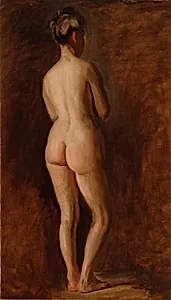
Standing Female Nude (back view)
Classification
Painting
Department
Smithsonian Collection
Museum
Smithsonian American Art Museum
Credit
Hirshhorn Museum and Sculpture Garden, Smithsonian Institution, Washington, DC, Gift of Joseph H. Hirshhorn, 1966
Accession Number
66.1481
Rights
Public Domain
About this artwork
Jh Purchased From Babcock Galleries, New York 1957
Art Historical Context
Thomas Eakins (1844–1916), one of America's foremost realist painters from, captured the human form with unflinching precision in *Standing Female Nude ( view)*, created in 1908. This late-career painting reflects Eakins' lifelong dedication to anatomical accuracy, through his studies at Jefferson Medical College and his controversial tenure at the Pennsylvania Academy of Fine Arts. By focusing on the back view, Eakins viewers to contemplate the subtle play of light and shadow across the spine, muscles, and contours, emphasizing structure over idealization—a hallmark of his realist style that challenged Victorian-era conventions. Eakins' nude studies were groundbreaking in American art, advocating for direct observation from live models, including women, which sparked scandal and led to his dismissal from teaching in 1886. This work exemplifies his scientific approach, treating the body as both a subject of beauty and a anatomical marvel. Though the medium remains unspecified, its classification as a painting underscores Eakins' mastery of oil techniques to render lifelike textures. Acquired from Babcock Galleries in New York in 1957 and gifted to the Hirshhorn Museum and Sculpture Garden by Joseph H. Hirshhorn in 1966, it now graces the Smithsonian American Art Museum. A testament to Eakins' enduring influence, this piece reminds us of art's power to reveal the everyday extraordinary.