
Standing Four-Armed Vishnu
Unknown Artist
5th century
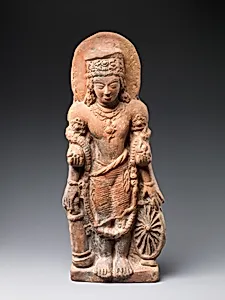
Medium
Terracotta
Dimensions
H. 10 1/4 in. (26 cm); W. 4 in. (10.2 cm); D. 1 3/4 in. (4.4 cm)
Classification
Sculpture
Culture & Period
India (Uttar Pradesh) · Gupta period
Department
Asian Art
Museum
Metropolitan Museum of Art, New York, NY
Credit
Samuel Eilenberg Collection, Gift of Samuel Eilenberg, 1987
Accession Number
1987.142.293
Rights
Public Domain
Tags
Art Historical Context
This exquisite terracotta sculpture, *Standing Four-Armed*, hails from 5th-century Uttar Pradesh during India's Gupta period—a golden age of art and culture often called the classical era of Hinduism. Crafted by an unknown artist, the 10¼-inch-tall figure depicts the god Vishnu, the cosmic preserver in the Hindu trinity, standing with four arms extended, symbolizing his divine multi-tasking power to protect the universe. The compact size (just 4 inches wide) suggests it was likely a devotional object for a household shrine, making divinity accessible in everyday life. Terracotta, fired clay molded and hand-finished, was a favored medium in Gupta India for its affordability and warmth, allowing intricate details like Vishnu's serene posture, ornate jewelry, and symbolic attributes (though worn by time). This piece exemplifies Gupta artistry's idealized forms and spiritual elegance, blending realism with divine abstraction. Part of the Metropolitan Museum of Art's Asian Art collection, gifted from Samuel Eilenberg's trove in 1987, it offers a tangible glimpse into ancient devotion and the era's artistic mastery.