
Standing Indra
Unknown Artist
ca. 2nd century
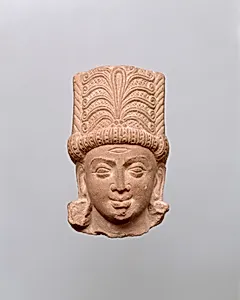
Medium
Sandstone
Dimensions
a): Head: H. 3 3/4 in. (9.4 cm); b): Body (lower waist down): H. 11 3/8 in. (28.9 cm)
Classification
Sculpture
Culture
India (Uttar Pradesh, Mathura or Ahicchatra)
Department
Asian Art
Museum
Metropolitan Museum of Art, New York, NY
Credit
Samuel Eilenberg Collection, Ex Coll.: Columbia University, Purchase, Rogers Fund, 1987
Accession Number
1987.218.12a, b
Rights
Public Domain
Tags
Art Historical Context
This exquisite sandstone sculpture, titled *Standing Indra*, dates to around the 2nd century and hails from the Kushan period in ancient India, likely crafted in the vibrant artistic hub of Mathura or Ahchatra in Uttar Pradesh Indra, the Vedic king of the gods and wielder of the thunderbolt, is depicted in a standing pose, though the piece survives in two fragments: a head measuring 3 3/4 inches high and a lower body from the waist down at 11 3/8 inches. Such fragmentary survivals are common for ancient Indian sculptures, offering glimpses into the grandeur of complete temple or shrine figures. Carved from Mathura's signature red or buff sandstone, the work exemplifies the Kushan school's bold, robust style, influenced by Greco-Roman, Persian, and indigenous Indian traditions under the multicultural Kushan Empire. Artisans favored this durable medium for its fine grain, allowing intricate details like jewelry, drapery folds, and dynamic anatomy that convey divine vitality. The serene facial features and muscular form reflect the era's emphasis on idealized divinity. Culturally, this sculpture underscores Mathura's role as a crossroads of Hindu, Buddhist, and Jain art production, where gods like Indra bridged mythology and devotion. Now in the Metropolitan Museum of Art's Asian Art Department from the Samuel Eilenberg Collection, it invites us to ponder the thunder god's enduring power in early Indian cosmology.