
Standing Lion
1833
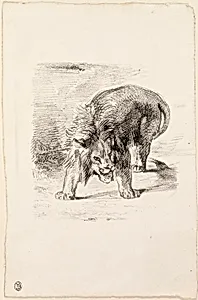
Medium
Lithograph in black on white wove paper
Dimensions
Image: 15 × 15 cm (5 15/16 × 5 15/16 in.); Sheet: 27 × 17.7 cm (10 11/16 × 7 in.)
Classification
lithograph
Department
Prints and Drawings
Museum
Art Institute of Chicago
Accession Number
22633
Rights
Public Domain
Art Historical Context
Behold the majestic *Standing Lion*, a striking 1833 lithograph by Eugène Delacroix, theeminent French Romantic artist. Captured in bold black ink on white wove paper, this square image (15 × 15 cm) depicts a powerful lion poised in vigilant stance, its muscular form radiating raw energy and nobility. Housed in the Art Institute of Chicago's and Drawings Department, this print exemplifies Delacroix's fascination with exotic animals as symbols of untamed nature and primal force. Delacroix, a leader of the Romantic movement, rejected neoclassical restraint in favor of emotional intensity and dramatic expression. Created just a year after his transformative trip to North Africa, *Standing Lion* likely draws from his on-site sketches, channeling the wild spirit he encountered in Moroccan zoos and landscapes. Lions, for Romantics, embodied heroism and the sublime, bridging art with the thrill of discovery. Lithography, a revolutionary 19th-century medium, allowed Delacroix to draw directly on lithographic stone with greasy crayon, producing rich, painterly tones through chemical printing. This technique democratized his virtuoso style, making high-art accessible via affordable prints. A testament to innovation, it highlights how Delacroix pushed printmaking toward the expressive freedom of painting.
About the Artist
Eugène Delacroix · 1798–1863
Eugène Delacroix (1798–1863) stands as the defining figure of French Romanticism and a pivotal bridge to modernism. Born in Charenton-Saint-Maurice near Paris, he came from distinguished lineage—his mother descended from the prestigious Oeben-Riesener furniture dynasty, while persistent speculation suggested the statesman Talleyrand may have been his biological father, a theory supported by physic...