
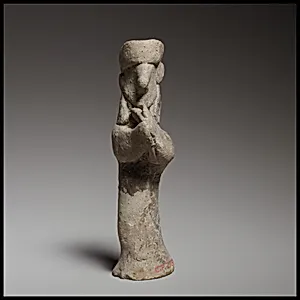
Standing male lyre player
Unknown Artist
ca. 600–480 BCE
Medium
Terracotta
Dimensions
H. 4 1/4 in. (10.8 cm)
Classification
Terracottas
Culture & Period
Cypriot · Cypro-Archaic II
Department
Greek and Roman Art
Museum
Metropolitan Museum of Art, New York, NY
Credit
The Cesnola Collection, Purchased by subscription, 1874–76
Accession Number
74.51.1688
Rights
Public Domain
Tags
Art Historical Context
This charming terracotta figurine, *Standing Male Lyre Player*, just 4¼ inches (10.8 cm) tall and dates to the Cypro-Aric II period (ca. 600–480 BCE). Crafted by an unknown Cypriot artist, it depicts a male musician poised with a lyre, a string instrument central to ancient performances. Such small-scale terracottas were likely votive offerings dedicated at sanctuaries or placed in tombs, reflecting everyday life and religious devotion on the island of Cyprus, a cultural crossroads blending Greek, Near Eastern, and Egyptian influences. Terracotta, fired clay molded and often hand-finished, was an accessible medium for Cypriot artisans, allowing mass production of expressive figures during the Archaic era. The lyre player captures the period's stylized anatomy—rigid posture, detailed attire, and attentive focus on the instrument—highlighting music's role in rituals, banquets, and festivals. These figurines offer rare glimpses into Cypriot society, where musicians held social prestige. Part of The Cesnola Collection at The Metropolitan Museum of Art's Greek and Roman Art Department (purchased 1874–76), this piece invites us to hear echoes of ancient melodies, bridging millennia to the vibrant world of Cypro-Archaic Cyprus.