
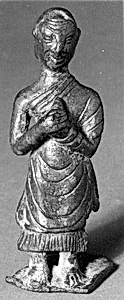
Standing Monk
Unknown Artist
3rd century
Medium
Bronze
Dimensions
H. 3 3/4 in. (9.5 cm)
Classification
Sculpture
Culture
Pakistan (ancient region of Gandhara)
Department
Asian Art
Museum
Metropolitan Museum of Art, New York, NY
Credit
Samuel Eilenberg Collection, Gift of Samuel Eilenberg, 1987
Accession Number
1987.142.206
Rights
Public Domain
Tags
Art Historical Context
This delicate bronze sculpture, *Standing Monk*, hails from the ancient Gandhara region in present-day Pakistan during the 3rd century CE. Standing just 3 3/4 inches (9.5 cm) tall, it captures a serene Buddhist monk in a poised, upright posture, embodying the spiritual discipline of early monastic life. Crafted in the Asian Art tradition at The Metropolitan Museum of Art (Samuel Eilenberg Collection, of Samuel Eilenberg 1987), this-scale figure was likely a devotional object, portable for personal worship or ritual use. Gandhara art flourished under the cultural crossroads of Greco-Roman, Persian, and Indian influences, producing some of the earliest realistic depictions of Buddhist figures. The use of bronze—cast through lost-wax techniques common in the region—allowed for intricate details in the monk's robes and stance, blending Hellenistic naturalism with symbolic Buddhist iconography. Though the artist remains unknown, such works highlight Gandhara's pivotal role in spreading Buddhism westward along the Silk Roads. This monk invites visitors to ponder the quiet devotion of ancient practitioners, a testament to art's power to preserve spiritual legacies across millennia.