
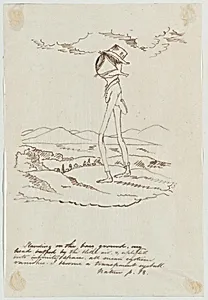
Standing on the Base Ground...I Become a Transparent Eyeball (Illustration for Ralph Waldo Emerson's "Nature")
1830–92
Medium
Pen and brown ink
Dimensions
sheet: 8 3/8 x 5 11/16 in. (21.3 x 14.4 cm)
Classification
Drawings
Department
Drawings and Prints
Museum
Metropolitan Museum of Art, New York, NY
Credit
Gift of Whitney Dall Jr., in memory of Emily Dall, 1976
Accession Number
1976.625.20(1)
Rights
Public Domain
Tags
About this artwork
This pen and brown ink, created in 1830–92, represents significant artistic achievement by Christopher Pearse Cranch, a American artist. The piece demonstrates the technical capabilities and aesthetic conventions of American art during this historical period. Working in pen and brown ink, the artist employed materials and techniques characteristic of the era, creating visual effects that convey both subject matter and artistic vision. Museum collections preserve such works to ensure continued st...
Art Historical Context
Christopher Pearse Cranch's *Standing on the Base GroundI Become a Transparent Eye* is a captivating pen and brown ink drawing created between 1830 and 1892, serving as an illustration for Ralph Waldo Emerson's seminal Transcendentalist essay ** (1836). This intimate sheet, measuring just 8 3/8 x 5 11/16 inches, visualizes Emerson's famous metaphor of the self dissolving into nature: standing on bare ground, the observer becomes a "transparent eyeball," bathed in infinite space and seeing all without ego. Cranch, an American artist and fellow Transcendentalist, brings this philosophical vision to life through a landscape vista, blending human perception with the sublime outdoors. Rendered in meticulous pen and brown ink, the work showcases 19th-century drawing techniques—fine lines and subtle shading—that evoke ethereal transparency and boundless vision. As a product of American Romanticism, it reflects the era's fascination with nature's spiritual power, aligning with Emerson's call to transcend individualism. Housed in the Metropolitan Museum of Art's Drawings and Prints department (gift of Whitney Dall Jr., 1976), this piece offers visitors a window into Transcendentalist culture, where art illuminated ideas of unity with the cosmos. Its preservation underscores the enduring appeal of such visionary imagery, inviting us to ponder our own place in the natural world.